Books

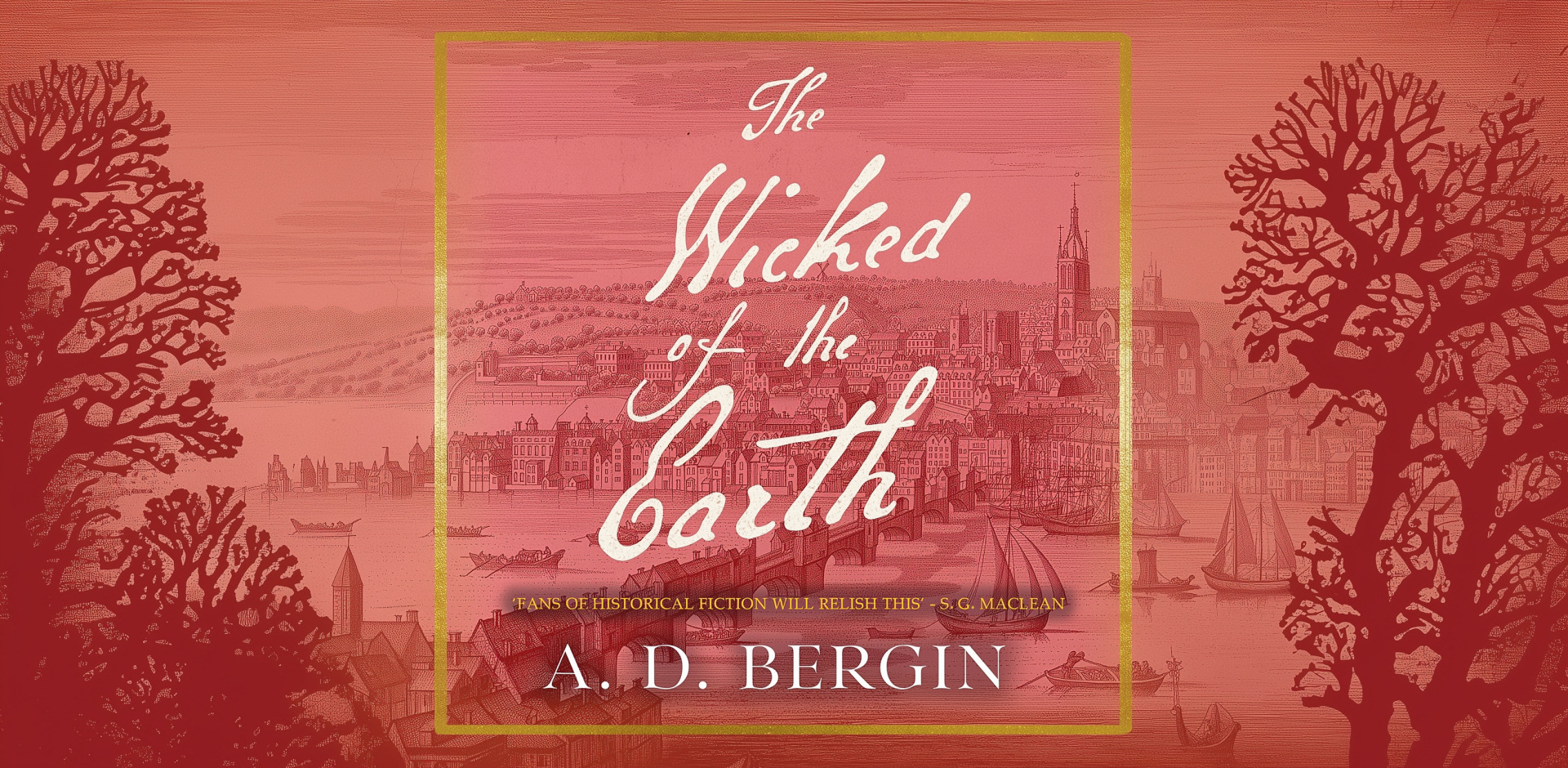
The Wicked of the Earth
AD Bergin
Review by Francis Sheppard
AD Bergin’s character James Archer presents initially as a two-dimensional hardman, a veteran of the English Civil War, goaded into a dangerous mission by the knowledge that events far away from London, where he is now billeted, have involved his sister. Further, this is the iron rule of Oliver Cromwell and the Council of State, and he has no choice. As he then rides north, leaving behind a London whose postwar economy is racing, he encounters scenes of ruin and hunger, the impact of the land’s neglect in times of civil conflict. This wintry landscape, of North Sea cold and folk without means to feed or clothe themselves adequately, under skies made thick with the burning of Newcastle coal (here again, the economy is beginning to boom) - forms backdrop to a tale of uncovered horror.
It is a world of deceit, corruption and violence. No party to the recent hostilities comes out well. Royalists, Catholics, Puritans – all have hands besmirched by coal, the source of so much wealth. The fighting has only deepened division; the only movement with integrity has been the Levellers, early democratic socialists, who of course have fallen victim to Cromwell’s power. Archer’s Protestant consciousness is revealed in his search for justice when he diverts from his journey to visit the memorial to Thomas Rainsborough, leader of the rebel cause.
Even as he calls at Doncaster, Archer is conscious of being watched; his journey done at Newcastle, where his origins lie, he is rapidly made aware of that he is widely viewed as a traitor, having escaped a besieged Royalist city to join the Parliamentarians in the south. He has been driven by conscience. What has at first been a commitment to find his young sister Meg and if necessary, avenge her death, is replaced by a political concern, to root the causes of the recent massacre. These are to be found in the rivalry between the various rich Newcastle merchants. It is their unconscionable greed that has led to the hanging of some thirty innocent women.
The Wicked of the Earth is historical fiction; I had only read Bring Up the Bodies by Hilary Mantel, and a few chapters of The Last Tudor by Philippa Gregory. The first I read as a novel, a piece of outstanding literature, Thomas Cromwell’s narrator-figure becoming clearer as character with all the bravery and sadness. Gregory’s work though seemed determinedly popular, with sharp humorous dialogue amid incipient romance, though in a courtier society at all times under threat by the capricious Elizabeth I.
I understand that the genre’s practitioners are scrupulous. While there is room for invention at a ‘personal’ level, the broad facts of the period must be adhered to. Historical events themselves can provide a setting or circumstance for the plot. In Gregory’s case it is the sensuous detail of the Tudor age, lived as it would have been by the nobility of the time It is largely the inner emotional life of these high-born characters that provides the page-by-page ‘stuff’ of the novel.
If there was a continuum between the popular and the literary as applied to historical fiction, then Bergin’s novel belongs most certainly on the literary side – though I sense that hi purpose is less to create an artistic ‘work’ than to tell of an event in relatively-modern history, that we of the present should know about. Suited to the grim topic, his style is admirably terse. There is a complete absence of phatic dialogue; every sentence announces further the web of corruption that this lonely man, James Archer, is set to expose. He is a true sufferer: not only rejected by his Northern kin for fighting against the Stuart king and his son, but bearing conscience for the way the New Model Army stormed through Ireland and the violence done to women – by soldiers other than himself. The contradictions of faith and the overall outcome of the war beset him. From the bloody battle of Drogheda he has emerged a hero however, with a junior-officer rank that has led to this commission. But warfare has left him scarred, both physically and mentally; his sleep is disturbed by images of women whom, on two occasions, he feels he has left to their fate. His uncovering of the events in Newcastle, and the justice that he effects, provide a kind of atonement.
This narrative, which drew me in more and more as I read it rapidly over eight days, is complex. The figures that Archer meets throw just enough light to give him direction. Thus there is a number of characters. To read the book over a longer period would risk confusion. The great facility of books – that the reader can re-read and check – must be resisted in the final few chapters, as the novel comes to its tense, mysterious close.